
Decarbonization: what it is and why it matters
1 min
Level
What is decarbonization, and why is it urgent? Learn practical steps companies can take to support the global move toward net zero emissions.


By Stephanie Safdie, US Copywriter, on 03/20/2026
Updated by Kara Anderson
ISO 14001 isn't just a badge on a website - it’s the global gold standard for building a business that respects the planet. It gives your organization a clear, structured roadmap to pin down your environmental footprint and, more importantly, shrink it.
Companies today face a massive shift in expectations. Governments are tightening regulations, and investors now prioritise measurable sustainability over vague promises. By adopting this framework, you gain the transparency needed to prove your impact through a consistent, auditable process. It moves your environmental strategy from a best effort to a core part of your business resilience.
What ISO 14001 is and how it works
The key requirements of an environmental management system (EMS)
The main updates introduced in ISO 14001:2015
The benefits of implementing ISO 14001
The steps to achieve ISO 14001 certification

Think of ISO 14001 as the universal blueprint for an Environmental Management System (EMS). It doesn't hand you a rigid list of dos and don'ts or set arbitrary carbon targets. Instead, it gives you the scaffolding to build a system that fits your specific footprint - whether you're a tech startup or a global manufacturer.
The standard is built to be modular. It scales precisely to your size, your industry, and your local regulatory landscape, ensuring the framework supports your business rather than complicating it.
The standard operates on a cycle of continuous improvement known as Plan–Do–Check–Act (PDCA). This ensures that environmental management is integrated into your daily operations and decision-making, rather than treated as a standalone project.
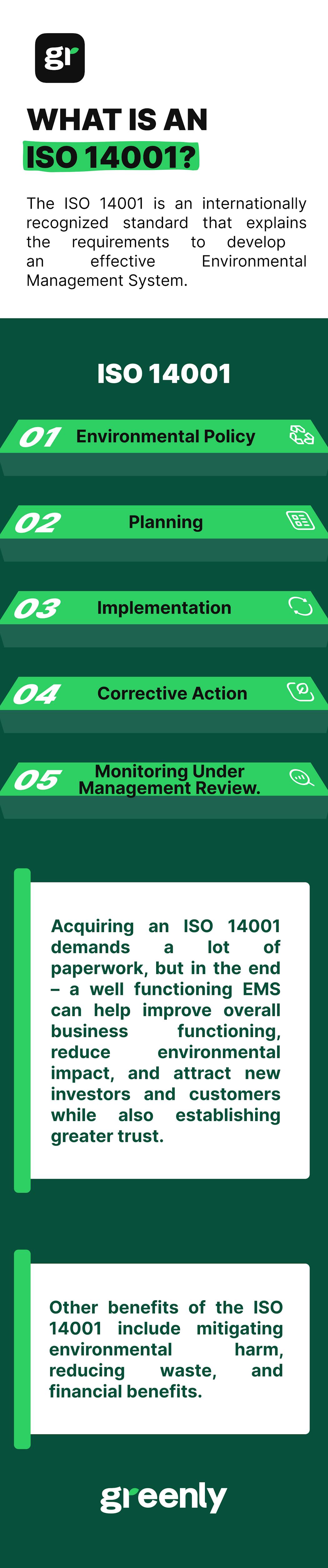
In practice, an ISO 14001 system involves several core elements:

By weaving these elements into your existing business processes, you move from reactive firefighting to a proactive, auditable, and scalable environmental strategy.

Built for the modern business landscape, ISO 14001:2015 (the current version of the standard), provides a structured framework for managing environmental impact through a lens of risk and opportunity. Rather than acting as a static manual, these requirements are designed to be woven directly into your daily operations to drive measurable, long-term performance.
To achieve certification, an organization needs to address these six critical areas:
Organizational Context
Before managing the environment, you have to understand your place in it. This involves identifying the internal and external factors that affect your performance - from local ecosystem health to the expectations of your investors and neighbours. Defining this context ensures your environmental strategy actually aligns with your high-level business goals.
Leadership and Commitment
ISO 14001:2015 moves accountability directly to the C-suite. Top management is expected to take an active role, which means setting the environmental policy, ensuring the right resources are in place, and making sure the system is woven into the company’s daily culture.
Strategic Planning
This stage is about identifying environmental aspects - the specific ways your activities interact with the planet (like waste or energy use). By assessing the risks and opportunities these interactions create, you can set measurable objectives that are both realistic and impactful.
Support and Operations
A plan is only as good as the people executing it. This requirement focuses on providing the necessary training, resources, and awareness for your team. It also introduces a life cycle perspective, encouraging you to consider the environmental impact of your products or services from design all the way through to disposal.
Performance Evaluation
You cannot manage what you do not measure. This phase involves consistent monitoring, internal audits, and formal management reviews. These checks ensure the system is working as intended and remains aligned with your original objectives.
Continuous Improvement
The final pillar is a commitment to never standing still. Whether it's addressing a nonconformity or refining a successful process, the standard requires a systematic approach to taking corrective actions and driving better environmental outcomes year after year.

The 2015 update wasn't just a minor polish; it was a fundamental shift toward making environmental management a strategic business tool. By moving away from a narrow compliance-only focus, the current version aligns more closely with how modern companies actually operate.
Key changes at a glance:
One of the most practical updates is the adoption of the Annex SL structure. This creates a high-level, identical framework across different ISO standards. If you already use ISO 9001 (Quality) or ISO 45001 (Health & Safety), integrating ISO 14001 is now a much more seamless process.
The 2015 version ends the era of delegated environmental management. Top management is now expected to take direct responsibility for the system's effectiveness. This ensures sustainability isn't siloed in a single department but is integrated into the core business strategy.
The standard now prioritizes prevention over correction. Instead of reacting to environmental issues after they happen, organizations are required to identify potential risks and opportunities early. This proactive approach helps businesses stay resilient in a rapidly changing regulatory landscape.
Rather than looking only at what happens within your own four walls, the 2015 update encourages a "cradle-to-grave" view. This means considering the environmental impact of your products and services throughout their entire life cycle - from raw material sourcing and design to final disposal.
The update acknowledges that a digital, fast-moving business doesn't need rigid, paper-heavy requirements. There is now much greater flexibility in how you document your processes, allowing you to develop a system that actually fits your workflow rather than one that just satisfies an auditor.
Environmental management is more closely linked to business strategy
Organizations are expected to take a proactive, rather than reactive, approach
Systems are easier to integrate with other ISO standards
There is greater flexibility in how requirements are implemented

Implementing ISO 14001 moves environmental management from a cost center to a driver of operational value. While compliance is the baseline, the real advantage lies in building a more resilient, efficient, and transparent business model.
ISO 14001 supports organizations in improving environmental performance while also delivering tangible business value, making it both a compliance tool and a strategic asset.
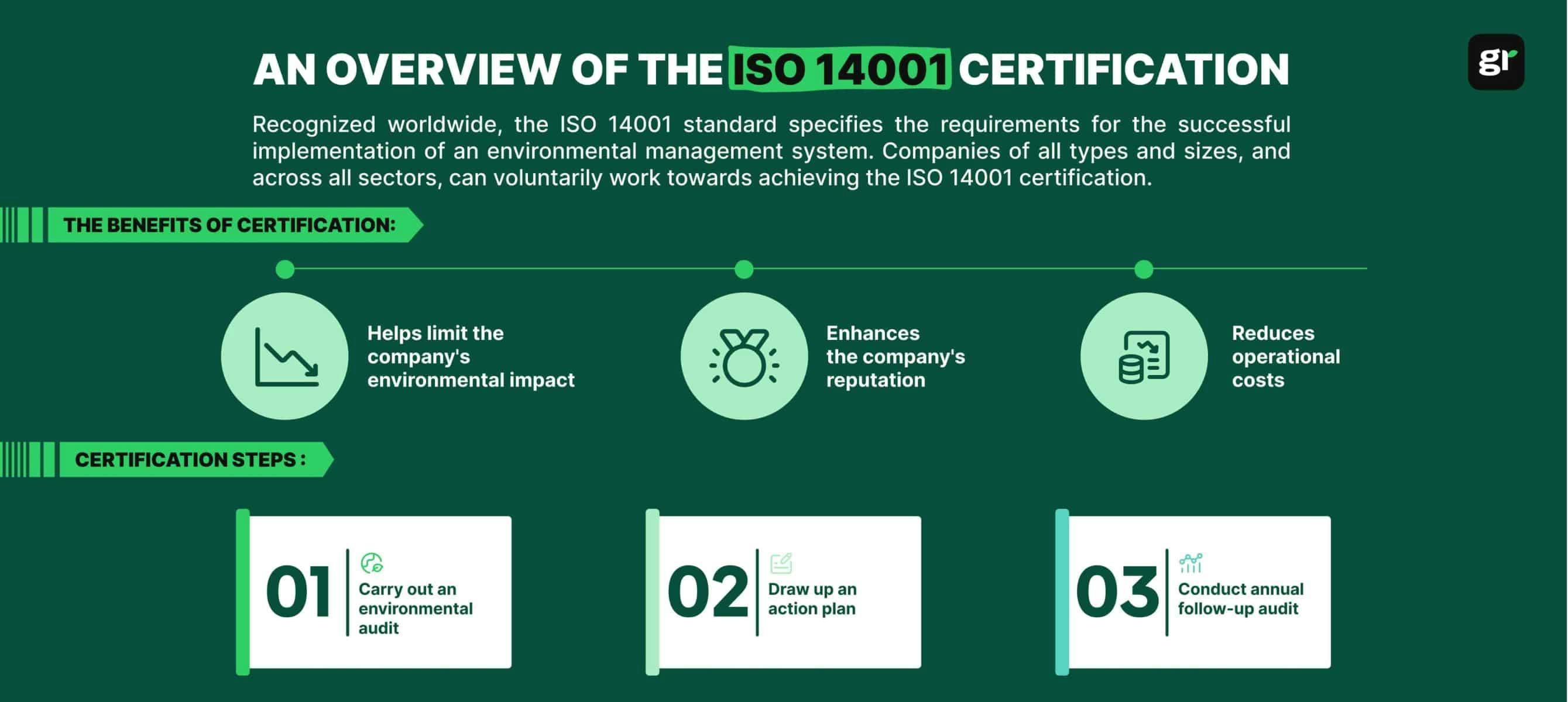
Achieving certification is a collaborative process designed to verify that your Environmental Management System (EMS) is both functional and effective. While the framework is rigorous, it is also flexible enough to scale with the specific size and complexity of your operations.
The journey begins by benchmarking your current environmental practices against the ISO 14001 requirements. This initial "audit of reality" helps you identify exactly where your existing systems fall short and allows you to define a clear, manageable scope for your EMS.
With the gaps identified, you can begin integrating the standard’s requirements into your daily business operations. This involves setting your environmental policy, defining measurable objectives, and establishing the operational controls needed to manage your specific footprint.
Before inviting an external body, you conduct your own internal review. This acts as a "dress rehearsal" to ensure your EMS is not only well-documented but is actually being followed by your team and delivering the intended results.
An independent, accredited body will then conduct a two-stage assessment:
Once these requirements are met, your organization is officially granted ISO 14001 certification.
ISO 14001 is a three-year cycle, not a one-time event. To ensure your system remains effective, you’ll undergo annual surveillance audits, followed by a full recertification at the end of the three years. This ongoing oversight ensures your commitment to environmental performance stays sharp as your business grows.
Misunderstanding the scope of ISO 14001 is one of the biggest hurdles to a successful rollout. When teams operate on assumptions - whether they are overestimating the legal protections or underestimating the flexibility of the standard - the process becomes needlessly complicated. To build a system that actually serves your business, you need to separate the administrative myths from the operational realities.
No standard can act as an automated 'get out of jail free' card. What ISO 14001 actually does is provide the rigorous framework needed to identify, monitor, and meet your legal obligations. It is a risk-reduction engine that makes non-compliance far less likely by keeping your regulatory requirements front and center.
The standard doesn’t walk into your office and demand a 20% reduction in carbon emissions by Tuesday. It is non-prescriptive, meaning it provides the method for improvement, while you define the metrics. You set the objectives based on what is actually relevant to your specific industry and strategic goals.
This is a common point of confusion. The International Organization for Standardization (ISO) develops the rules, but they don't hand out the trophies. Certification is always performed by independent, accredited third-party bodies that audit your system to verify it meets the ISO criteria.
Many small-to-medium enterprises (SMEs) avoid the standard because they assume it’s too bureaucratic. In truth, the framework is built to be scalable. Whether you are a three-person consultancy or a multinational manufacturer, the system is designed to be proportionate to your actual resources and environmental impact.

ISO 14001 provides organizations with a structured and internationally recognized framework to manage environmental responsibilities in a consistent and strategic way. By embedding environmental management into core business processes, it enables organisations to improve performance, reduce risks, and respond effectively to increasing regulatory and stakeholder expectations.
As environmental considerations become more central to business strategy - particularly in the context of ESG reporting and evolving regulations - standards like ISO 14001 play an important role in supporting transparency, accountability, and long-term resilience.
Whether organizations are seeking certification or simply looking to strengthen their environmental practices, ISO 14001 offers a practical and scalable foundation for continual improvement.
ISO 14001 certification is a formal recognition that an organization’s environmental management system (EMS) meets the requirements of ISO 14001:2015. It is issued by an independent, accredited certification body following a successful audit.
The timeline varies depending on the organization’s size and complexity, but typically ranges from 3 to 12 months. Factors include existing processes, resource availability, and readiness for audit.
Costs vary widely depending on organization size, scope, and certification body, but generally include:
- Implementation costs (internal resources, consultants, tools)
- Audit and certification fees
- Ongoing surveillance audit costs
Small organizations may spend a few thousand, while larger organizations may incur significantly higher costs.
No, ISO 14001 is a voluntary standard. However, it is often required by clients, regulators, or procurement processes, particularly in regulated or international markets.
ISO 14001 is a management system standard focused specifically on environmental performance. ESG (Environmental, Social, Governance) is a broader framework used by investors and stakeholders to assess overall sustainability and corporate responsibility.
Yes. ISO 14001 is designed to be scalable and can be adapted to organizations of any size. Small and medium-sized enterprises (SMEs) can implement a simplified EMS aligned with their resources and environmental impact.
Certification is typically valid for three years, subject to annual surveillance audits. Organizations must undergo a recertification audit at the end of each cycle.
ISO 14001 does not specifically require carbon footprint measurement, but it does require organisations to identify and manage significant environmental aspects. For many organizations, this includes greenhouse gas emissions.
ISO 14001 is used across a wide range of industries, including manufacturing, construction, energy, logistics, technology, and services. It is applicable to any organization seeking to manage environmental impact.
If nonconformities are identified during an audit, the organization must address them through corrective actions. Certification is granted once these issues are resolved and verified by the certification body.

ISO

EPA and and
Netsol Water
SGS Group
Toyota
Coca-Cola
Canon
ANSI
IAF
Share this article


What is decarbonization, and why is it urgent? Learn practical steps companies can take to support the global move toward net zero emissions.

In this article, we’ll break down what IROs are, how to identify and assess them, and what CSRD requires in terms of disclosure.

In this article, we break down what the EU CBAM is, how it works, and what businesses need to do to comply.
